


The rise of smart surface technology is ushering in a new trend in automotive interiors
In the future, smart surface technology will become increasingly widespread, encompassing multiple fields such as kitchen appliances, automotive interiors, medical devices, and furniture. These surfaces will integrate various functions including lighting, touch sensing, heating, and haptic feedback, transforming static objects into seamlessly integrated user interfaces with a sophisticated design. Currently, the industry is actively exploring methods for efficiently manufacturing these high-end smart surfaces. Among them, the emerging in-mold electronics (IME) manufacturing technology seems to offer a new solution to this challenge. Compared to traditional mechanical switches, IME technology not only significantly reduces product weight and material consumption (up to 70%), but also achieves the same functionality by reducing the number of components, bringing a revolutionary change to the manufacturing of smart surfaces.
IME Manufacturing Technology
IME manufacturing technology involves a variety of materials, such as conductive and dielectric inks, conductive adhesives, transparent conductors, substrates, and thermoplastics. This technology not only emphasizes sustainability but also greatly promotes the integration of electronic components.
IML/IMC/IME - Process Flow Comparison
With the further development of In-Mold Decoration (IMD) technology, IME technology has emerged, enabling the transformation of decorative thermoformed plastics into 3D components through injection molding. This technology cleverly integrates multiple manufacturing processes such as screen printing, pick-and-place technology, thermoforming, and injection molding, creating entirely new components while retaining existing functionality.
However, intelligent surface manufacturing methods also face numerous technical challenges. During thermoforming and injection molding, electronic functions must withstand corresponding temperature and pressure variations. Simultaneously, high manufacturing yield becomes a critical factor, as any failure during circuit embedding can lead to overall component failure. Furthermore, key materials such as conductive and dielectric inks and adhesives need to be specially adapted to high-temperature molding conditions, and all materials must maintain high compatibility. To address these challenges, many suppliers have developed functional ink combinations specifically for IME technology.
IME Processing Flow Explained
IME technology not only integrates multiple manufacturing processes but also enables sensor fusion, thus supporting widely used Class A surface materials. This technology brings diverse functional options to HMI controllers. Furthermore, its open-frame design maintains high performance and accuracy across varying thicknesses, for example, through the integration of piezoelectric sensors for online data collection and machine learning.
Innovative Applications of Smart Surfaces in Automotive Interiors
With the rapid advancement of smart surface technology, the sophistication and intelligent touch experience of automotive interiors are constantly improving. Traditional IML (In-Mold Decoration) processes have been gradually replaced by IMC (In-Mold Circuitry) and IME (In-Mold Electronics) processes. These breakthroughs in key technologies have enabled smart surfaces to be widely applied in various fields such as new energy vehicles, aircraft, home appliances, and consumer electronics. In automotive interiors, this technology not only simplifies design and provides intuitive touch control, reducing driver distraction, but also significantly reduces the size and cost of displays. More notably, it can detect touches under metal and sense them on solid surfaces, thus completely eliminating bulky physical control components.
Comparison of IML, IMC, and IME Processes
IME technology makes automotive interior components, such as the center console and top control panel, lighter, simpler, and easier to manufacture. Its advantage lies in simplifying the version control process, as the same mold can be used to manufacture parts with different appearances and functions. With the continuous development of smart surfaces, we can expect to see more complex interaction methods emerge, surpassing traditional capacitive sensors or switches. For example, printed pressure sensors may be applied to control panels, providing a wider range of input options. Simultaneously, haptic feedback technology will be widely used to reduce driver distraction, thereby improving driving satisfaction and safety. Although autonomous driving technology is not yet fully widespread, automakers have begun preparing to provide drivers with more autonomy through interior personalization and convenient connectivity. For example, Faurecia's interior system improvements in HMI are a good example, employing novel decorative materials and achieving numerous advanced features such as a high-resolution AMOLED screen, functional smart surfaces, new mobile device connectivity, and an automatically adjusting comfort position system.
HMI Innovation in Automotive Interiors
Curved glass technology, once widely used in smartphones, has now crossed over into the automotive interior field. This glass can not only be coated and printed on, but also bent into curved shapes, while possessing excellent scratch and impact resistance.
Innovative Applications of Curved Glass
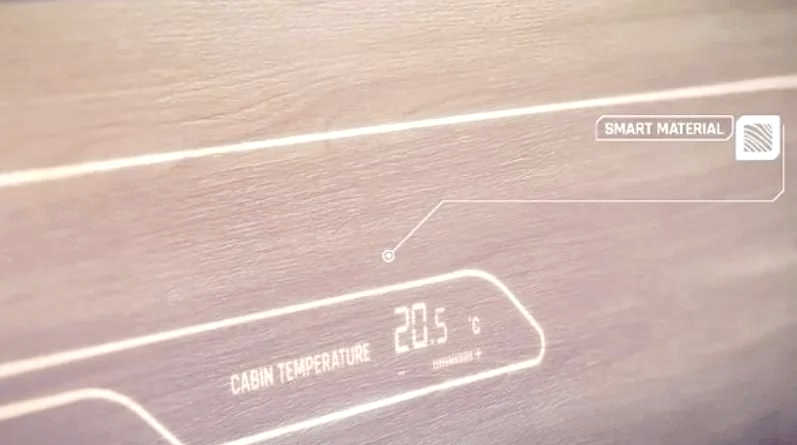
Through IME technology, plastic surfaces can achieve the textures of wood, metal, or leather. This effect, combined with backlit information displays, ambient lighting, and touch-sensitive control surfaces, brings a completely new visual and tactile experience to automotive interiors. Furthermore, the synergy between the controller and the touchscreen display allows for simple and intuitive control of various functions within the cabin, such as temperature and lighting.
Innovative Design of Smart Material Interiors
The multi-functional interactive system integrated into the steering wheel features a free-floating design, providing not only convenient display functions but also easy operation for the driver.
Innovative Applications of Smart Surface Steering Wheels
With the continuous development of smart technology, smart surface steering wheels are gradually becoming a new favorite in automotive interiors. It is predicted that the smart material interior market will reach $2 billion by 2033. This technology encompasses various applications such as in-mold electronics and touch sensors, bringing revolutionary changes to automotive interiors. In the future, mechanical and capacitive switch-based human-machine interaction methods will gradually be replaced by smart surface steering wheels, providing drivers with a more convenient and safer driving experience.


Leave your message