


IML
IML (In-Mold Labeling / In-Mold Lamination) is a surface decoration technology that integrates a pre-printed decorative film with the injection molding process.
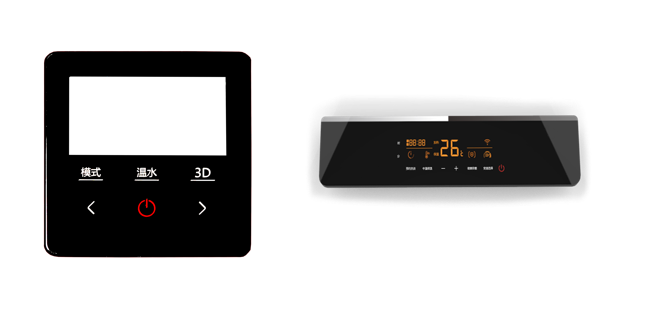
IML Process Flow
1. Film Substrate Preparation
Select PC/PET film (common thicknesses: 0.125mm, 0.175mm, 0.2mm).
Apply a hard coating (HC) layer (2H~4H) on the front side of the film to enhance scratch resistance.
2. Screen Printing / UV Printing
Print graphics, base colors, light-blocking layers, and metallic effect inks on the back side of the film.
Critical: Inks must be IML-specific high-temperature resistant inks to prevent washout, melt-through, or blistering caused by high-temperature injection molding. Each ink layer must be fully dried and cured.
3. Thermoforming
Heat the printed film (160~220°C) and use vacuum-assisted high-pressure stretching to form it into the product's curved shape.
Limitation: The draw ratio cannot be excessive. Deep-drawn or large-drop products are prone to pattern distortion due to stretching.
4. Precision Die-Cutting
Use a steel rule die or laser cutting to trim excess material, obtaining individual films that match the product contour.
Dimensional tolerance control: ±0.05~0.1mm.
5. In-Mold Placement
Place the formed film insert into the injection mold's front half using a robotic arm or manual operation.
Secure it with vacuum suction and/or electrostatic force to prevent displacement during injection.
6. Injection Molding
Close the mold and inject molten plastic (commonly ABS, PC/ABS, or PC).
The high-temperature plastic bonds tightly to the back of the film. After cooling, the film and plastic fuse into a single integrated part.
7. Demolding → Gate and flash trimming → Full inspection → Finished product


Leave your message